
Introduction to Specification Changes from HDMI 1.0 to HDMI 2.1 (Part 1)
Since the release of the world’s first Blu-ray player, the Samsung BD-P1000, in 2006, which adopted HDMI, the vast majority of Blu-ray players and full HD playback devices have been equipped with HDMI. Since then, HDMI has been unstoppable and has dominated the cable industry for many years, covering both consumer and industrial audio and video transmission sectors.

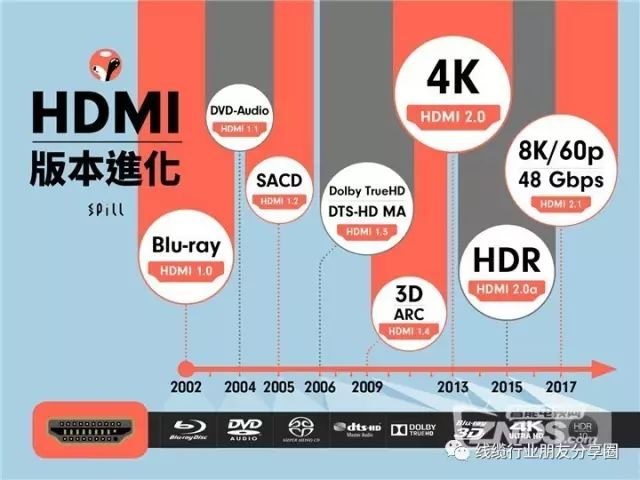
Evolution of HDMI versions
1.4 and 2.0 are the most common
2.0a supports 4K HDR
HDMI 1.0
Supports Blu-ray and Full HD 1080/60Hz
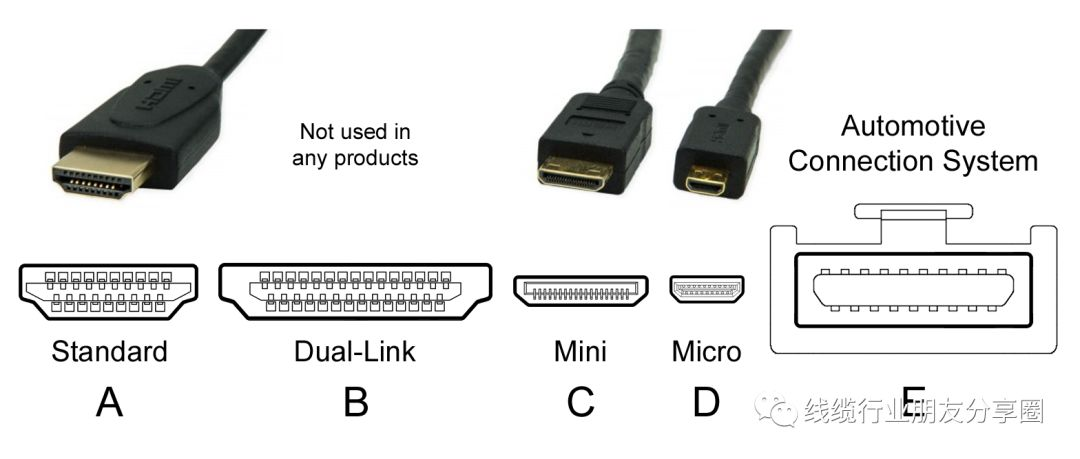
HDMI 1.0 was released on December 9, 2002. It is a single-line digital audio/video connector interface. The link architecture is based on DVI and uses the same video transmission format, but transmits audio and other auxiliary data during the intervals of the video stream. HDMI 1.0 allows a maximum TMDS clock of 165 MHz (each link’s bandwidth is 4.95 Gbit/s), the same as DVI. It defines two types of connectors called A-type and B-type, which respectively use pinouts based on single-link DVI-D and dual-link DVI-D connectors, although the B-type connector has never been used in any commercial product. HDMI 1.0 uses 8 b/10 b encoding for video transmission, giving it a video bandwidth of 3.96 Gbit/s (1920×1080 or 1920×1080 60Hz) and 8-channel LPCM/192 kHz/24-bit audio. HDMI 1.0 requires support for RGB video, and optionally supports Y′CBCR 4:4:4 and 4:2:2 (forced if the device supports Y′CBCR other interfaces). Color depth of 10 bpc (30 bits/pixel) or 12 bpc (36 bits/pixel) allows the use of 4:2:2 subsampling, but only 8 bpc (24 bits/pixel) color depth is allowed when using RGB or Y′CBCR 4:4:4. Only Rec. 601 and Rec. 709 color spaces are supported. HDMI 1.0 only allows specific predefined video formats, including all formats defined in EIA/CEA-861-B and some other formats listed in the HDMI specification. All HDMI sources/receivers must also be able to send/receive native single-link DVI video and fully comply with the DVI specification.
The earliest HDMI version, released in December 2002, can be said to be specifically designed for full HD software such as Blu-ray at that time. Its main feature is the integration of video and audio transmission at the same time. Compared to the pure video transmission interfaces on computers such as DVI and DisplayPort, it is more suitable for audio-visual equipment. HDMI 1.0 already supports DVD and Blu-ray video, with a maximum bandwidth of 4.95 Gbps, of which 3.96 Gbps is used for transmitting video streams, capable of supporting 1080/60p or UXGA resolution; in terms of audio, it supports 8-channel LPCM 24bit/192kHz, meaning it has already reached multi-channel Hi-Res audio. In the comparison of cable specifications at that time, it was quite strong.
HDMI 1.1
HDMI 1.1 was released on May 20, 2004, and added support for DVD-Audio.
It was launched in May 2004 and included new support for DVD-Audio. DVD-Audio stores 16-bit/44.1kHz to 24-bit/192kHz PCM music on DVD discs. It was originally intended to be the successor to CD as the same as SACD, but unfortunately, both formats failed to gain widespread popularity.
HDMI 1.2
Support for SACD
It was released in August 2005, adding support for 1-bit audio, also known as SACD audio streaming, up to 8 channels. DMI CEC allows one remote control to control all compatible devices, which is very convenient.
HDMI 1.2 was released on August 8, 2005, and added a bit audio option for Super Audio CD, up to 8 channels. To make HDMI more suitable for use on PC devices, version 1.2 also removed the requirement of only using explicitly supported formats. It increased the ability of manufacturers to create formats specific to the supplier, allowing for any resolution and refresh rate, not limited to the predefined list of supported formats. Additionally, it added explicit support for some new formats including 720p at 100 and 120Hz and relaxed pixel format support requirements, so that sources with only local RGB output (PC) would not be required to support Y′CBCR output.
Post time: Aug-29-2025


