
Introduction to Type-C Interface
The birth of Type-C is not long ago. The renderings of Type-C connectors only emerged at the end of 2013, and the USB 3.1 standard was finalized in 2014. It gradually became popular in 2015. It is a new specification for USB cables and connectors, a complete set of brand-new USB physical specifications. Google, Apple, Microsoft, and other companies have been promoting it vigorously. However, it takes much more than a day for a specification to develop from its birth to maturity, especially in the consumer product market. The application of the Type-C physical interface is the latest achievement after the update of the USB specification, which was initiated by major companies such as Intel. Compared with the existing USB technology, the new USB technology uses a more efficient data encoding system and provides more than double the effective data throughput rate (USB IF Association). It is fully backward compatible with existing USB connectors and cables. Among them, USB 3.1 is compatible with the existing USB 3.0 software stack and device protocols, 5Gbps hubs and devices, and USB 2.0 products. Both USB 3.1 and the currently commercially available USB 4 specification adopt the Type-C physical interface, which also indicates the arrival of the mobile Internet era. In this era, more and more devices – computers, mobile phones, tablets, TVs, e-book readers, and even cars – can be connected to the Internet in different ways, gradually eroding the data distribution center status symbolized by the Type-A interface. USB 4 connectors and cables are beginning to enter the market.
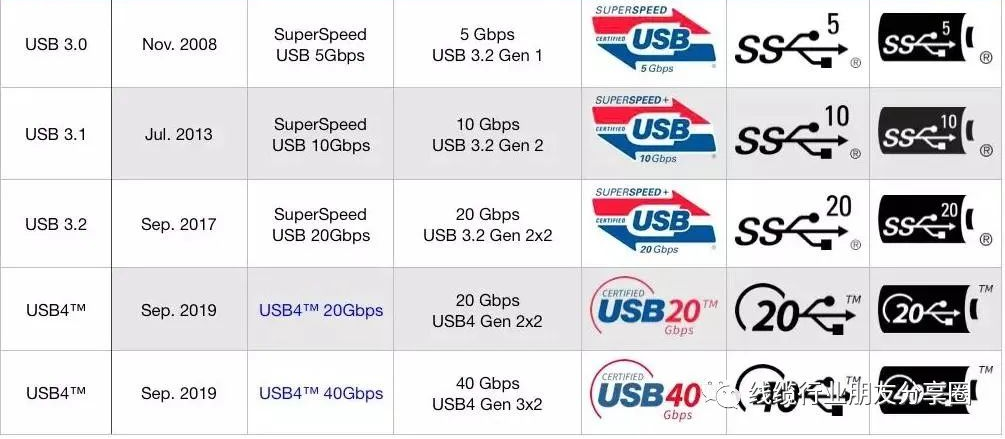
Theoretically, the maximum data transfer rate of the current Type-C USB4 can reach 40 Gbit/s, and the maximum output voltage is 48V (the PD3.1 specification has increased the supported voltage from the current 20V to 48V). In contrast, the USB-A type has a maximum transfer rate of 5Gbps and an output voltage of 5V so far. The standard specification connection line equipped with a Type-C connector can carry a current of 5A and also supports “USB PD” beyond the current USB power supply capacity, which can provide a maximum power of 240W. (The new version of the USB-C specification has arrived: supporting up to 240W power, requiring an upgraded cable) In addition to the above improvements, Type-C also integrates DP, HDMI, and VGA interfaces. Users only need one Type-C cable to deal with the trouble of connecting external displays and video output that previously required different cables.
Nowadays, there are a wide variety of Type-C related products on the market. For example, there is a Type-C Male to Male cable that supports USB 3.1 C to C and 5A 100W high-power transmission, which can achieve 10Gbps high-speed data transmission and has USB C Gen 2 E Mark chip certification. In addition, there are USB C Male to Female adapters, USB C Aluminum metal shell cables, and high-performance cables such as USB3.1 Gen 2 and USB4 Cable, which meet the connection needs of different devices. For special scenarios, there are also 90-degree USB3.2 cable elbow designs, front panel mount models, and USB3.1 Dual-Head double-headed cables, among other diverse options.
Post time: Aug-27-2025


