
Technical Overview of HDMI 2.1b Specification
For audio and video enthusiasts, the most familiar equipment is undoubtedly HDMI cables and interfaces. Since the release of the 1.0 version of the HDMI specification in 2002, it has been over 20 years. Over the past 20-plus years, HDMI has become the most widely used interface standard in audio and video devices. According to official records, the shipment volume of HDMI devices has reached 11 billion units, which is equivalent to nearly two HDMI devices per person globally. The greatest advantage of HDMI is the uniformity of its standard. Over the past 20 years, the physical size of the standard HDMI interface has remained unchanged, and the software protocol has achieved complete backward compatibility. This is particularly convenient for large household appliances with slower hardware updates, especially televisions. Even if the TV at home is an old model from over a decade ago, it can be directly connected to the latest next-generation game consoles without the need for adapters. Therefore, in recent years, HDMI has rapidly replaced the past component video, AV, audio, and other interfaces on televisions and has become the most common interface on televisions. According to statistics, all television products on the market in 2024 use HDMI technology, and HDMI has also become the best carrier for high-definition formats such as 4K, 8K, and HDR. The HDMI 2.1a standard has been upgraded again: it will add power supply capabilities to the cables and requires the installation of chips in the source devices.
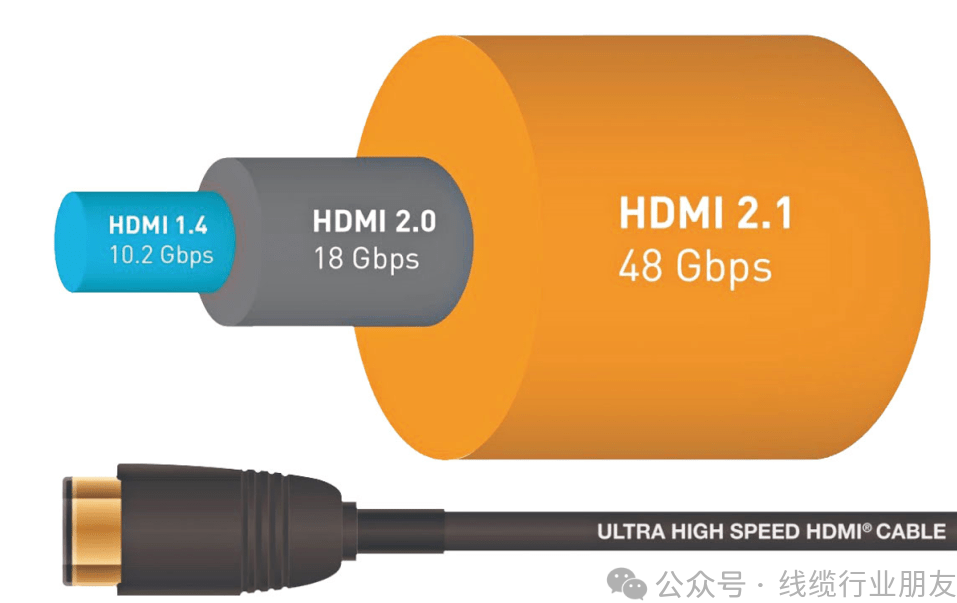
The HDMI® Specification 2.1b is the latest version of the HDMI® Specification, supporting a range of higher video resolutions and refresh rates, including 8K60 and 4K120, as well as resolutions up to 10K. It also supports dynamic HDR formats, with bandwidth capacity increasing to 48Gbps HDMI. The new Ultra High Speed HDMI cables support 48Gbps bandwidth. These cables ensure the provision of ultra-high bandwidth independent features, including uncompressed 8K video with HDR support. They have ultra-low EMI (electromagnetic interference), reducing interference with nearby wireless devices. The cables are backward compatible and can also be used with existing HDMI devices.
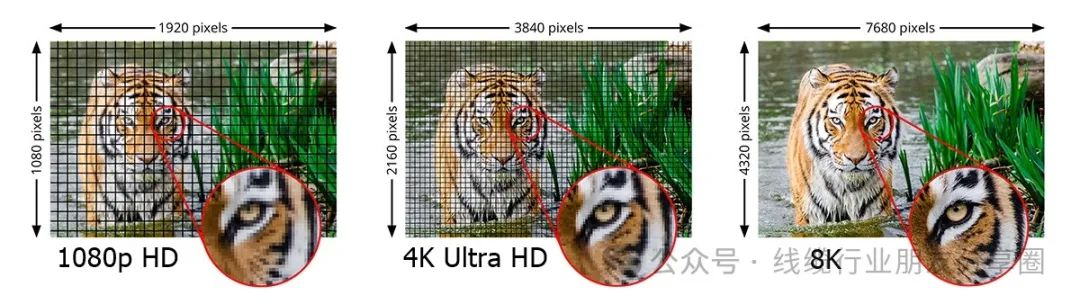
The features of HDMI 2.1b include:
Higher video resolution: It can support a range of higher resolutions and faster refresh rates (including 8K60Hz and 4K120Hz), providing an immersive viewing experience and smooth fast-motion details. It supports a resolution of up to 10K, meeting the needs of commercial AV, industrial, and professional applications.
Dynamic HDR ensures that every scene and even every frame of the video displays the ideal values of depth, details, brightness, contrast, and a wider color gamut.
Source-based tone mapping (SBTM) is a new HDR feature. Besides the HDR mapping completed by the display device, it also enables the source device to perform part of the HDR mapping. SBTM is particularly useful when combining HDR and SDR videos or graphics into a single image, such as picture-in-picture or program guides with integrated video windows. SBTM also allows PC and gaming devices to automatically generate optimized HDR signals to make the most of the HDR capabilities of the display without the need for manual configuration of the source device.
Ultra-high-speed HDMI cables can support the uncompressed HDMI 2.1b function and the 48G bandwidth it supports. The emitted EMI from the cables is very low. They are also backward compatible with earlier versions of the HDMI standard and can be used with existing HDMI devices.
The HDMI 2.1b specification replaces 2.0b, while the 2.1a specification continues to refer to and rely on the HDMI 1.4b specification. HDMI®
Identification method for HDMI 2.1b products
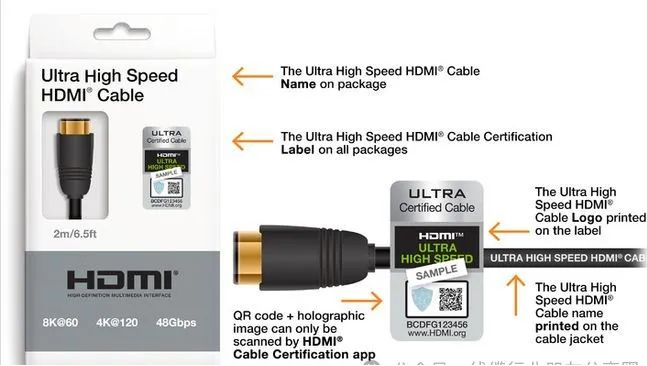
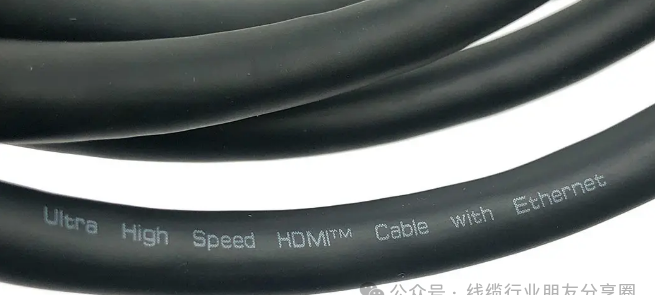
The HDMI 2.1b specification includes a new cable – Ultra High-Speed HDMI® Cable. It is the only cable that complies with strict specifications, aiming to ensure the support of all HDMI 2.1b functions, including uncompressed 8k@60 and 4K@120. The enhanced bandwidth capacity of this cable supports up to 48Gbps. All certified cables of any length must pass the certification tests of the HDMI Forum Authorized Testing Center (Forum ATC). Once certified, the cable will need to have the Ultra High-Speed HDMI certification label affixed on each package or sales unit, so that consumers can verify the certification status of the product. To identify the cable, make sure the required Ultra High-Speed HDMI certification label as shown above is displayed on the packaging. Note that the official cable name logo is printed on the label. This name also needs to appear on the outer sheath of the cable. To verify whether the cable has been tested and certified and complies with the HDMI 2.1b specification, you can scan the QR code on the label using the HDMI cable certification application available in the Apple App Store, Google Play Store, and other Android application stores.
The standard HDMI 2.1b version data cable has 5 pairs of twisted wires inside the cable, with the outer color sequence being yellow, orange, white, red, and there are 2 groups of connections for a total of 6 wires, making a total of 21 wires. Currently, the quality of HDMI cables varies greatly and there are significant differences. The disorderliness is far beyond imagination. Some manufacturers can produce 3-meter finished products with 30AWG wires that meet EMI standards and have a bandwidth of 18G, while some manufacturers’ extracted wires have a bandwidth of only 13.5G, others have a bandwidth of only 10.2G, and some even have a bandwidth of only 5G. Fortunately, the HDMI Association has detailed specifications, and by comparing them, one can determine the quality of the cable. The current cable structure definition: the aluminum foil wire in the 5P package is used for data transmission and one group of DDC signals for communication protocols. The functions of the 7 copper wires are: one for power supply, one for CEC function, two for audio return (ARC), one group of DDC signals (two core wires with foam and one ground wire with aluminum foil shielding) for communication protocols. Different material options and function combinations make the cable materials’ structure and performance design result in significant cost differences and a large price range. Of course, the corresponding cable performance also varies greatly. Below is the structural decomposition of some qualified cable products.
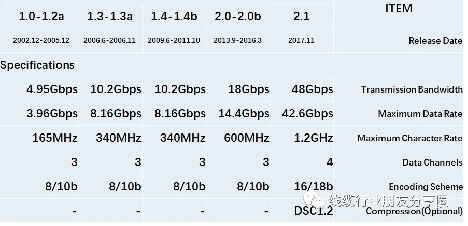
HDMI standard version
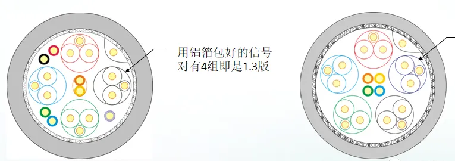
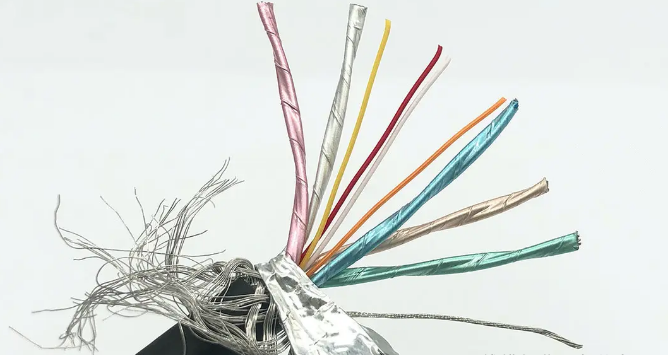
The outermost copper wire is woven. The single pair is made of Mylar material and an aluminum foil layer.
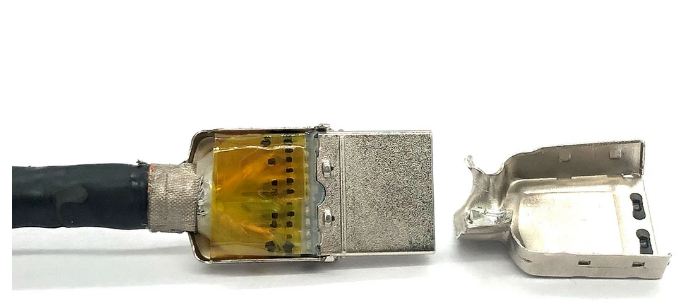
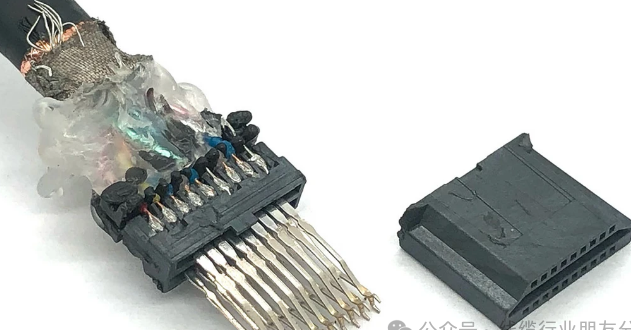
The interior is tightly wrapped by a metal shielding cover from top to bottom. When the metal cover on the top is removed, there is yellow high-temperature adhesive tape covering the inside. By peeling off the connector, it can be seen that each wire inside is connected by a data cable, which is also known as “full pins”. Especially, the top of the gold finger interface has a layer of gold plating, and the price difference of genuine products lies in these details.
Nowadays, there are various HDMI 2.1b cable variants that meet different usage scenarios on the market, such as Slim HDMI and OD 3.0mm HDMI cables, which are more suitable for compact spaces and concealed wiring;
Right Angle HDMI (90-degree elbow) and 90 L/T HDMI Cable, which are convenient for connecting devices in narrow positions;
MINI HDMI Cable (C-type) and MICRO HDMI Cable (D-type), suitable for portable devices such as cameras and tablets;
High-performance cables such as 8K HDMI, 48Gbps Spring HDMI, etc., ensure the stability of ultra-high bandwidth transmission;
Flexible HDMI and Spring HDMI materials have good resistance to bending and durability;
The Slim 8K HDMI, MINI and MICRO models with metal case shells further enhance the shielding and durability of the interface, especially suitable for high-interference environments or industrial applications.
When consumers purchase, in addition to recognizing the super-fast HDMI certification label, they should also combine their own device interface type (such as whether a mini HDMI to HDMI or micro HDMI to HDMI is needed) and usage scenarios (such as whether right angle or slim design is needed) to choose the most suitable HDMI 2.1b cable to ensure the best performance and compatibility.
Post time: Aug-20-2025


