
The Evolution of SAS Connector Technology: A Storage Revolution from Parallel to High-Speed Serial
Today’s storage systems not only grow at the terabit level, have higher data transfer rates, but also consume less energy and take up less space. These systems also require better connectivity to provide more flexibility. Designers need smaller interconnections to provide the current or future required data transfer rates. And it takes far more than a day for a specification to be born, develop and gradually mature. Especially in the IT industry, any technology is constantly improving and evolving, and the SAS (Serial Attached SCSI, Serial SCSI) specification is no exception. As the successor to parallel SCSI, the SAS specification has been in people’s view for some time.
Over the years that SAS has been around, its specifications have been continuously improved. Although the underlying protocol has remained largely unchanged, the specifications of external interface connectors have undergone multiple changes. This is an adjustment made by SAS to adapt to the market environment. For instance, the evolution of connector specifications such as MINI SAS 8087, SFF-8643, and SFF-8654 has greatly altered the cabling solutions as SAS transitioned from parallel to serial technology. Previously, parallel SCSI could operate at up to 320 Mb/s over 16 channels in either single-ended or differential mode. Currently, the SAS 3.0 interface, which is still widely used in enterprise storage, offers a bandwidth that is twice as fast as the long-unupgraded SAS 3, reaching 24 Gbps, which is approximately 75% of the bandwidth of a common PCIe 3.0 x4 solid-state drive. The latest MiniSAS HD connector described in the SAS-4 specification is smaller in size and can achieve higher density. The size of the latest Mini-SAS HD connector is half that of the original SCSI connector and 70% of the SAS connector. Unlike the original SCSI parallel cable, both SAS and Mini-SAS HD have four channels. However, along with higher speed, higher density, and greater flexibility, there is also an increase in complexity. Because the connector is smaller, cable manufacturers, cable assemblers, and system designers must pay close attention to the signal integrity parameters of the entire cable assembly.

All kinds of SAS cables and connectors, it’s really easy to make them look so dazzling… How many have you seen? Those used in industry, and those for consumer products? For example, the MINI SAS 8087 to 4X SATA 7P Male cable, the SFF-8643 to SFF-8482 cable, the SlimSAS SFF-8654 8i, etc.
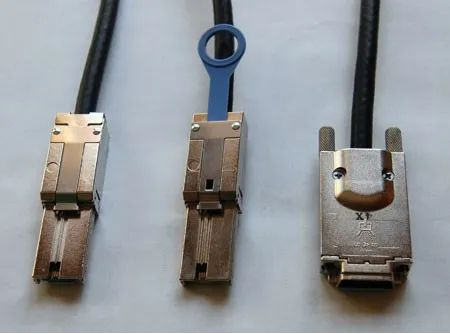
The width (left, middle) of the Mini-SAS HD cable is 70% of that of the SAS cable (right).
Not all cable manufacturers can provide high-quality high-speed signals to meet the signal integrity requirements of storage systems. Cable manufacturers need to provide high-quality and cost-effective solutions for the latest storage systems. For example, SFF-8087 to SFF-8088 cable or MCIO 8i to 2 OCuLink 4i cable. To produce stable and durable high-speed cable components, several factors need to be considered. In addition to maintaining the quality of processing and the processing process, designers also need to pay close attention to signal integrity parameters, which are precisely what make today’s high-speed storage device cables possible.
Post time: Aug-06-2025


