
Three Breakthroughs of HDMI 2.2 in ULTRA96 Certification
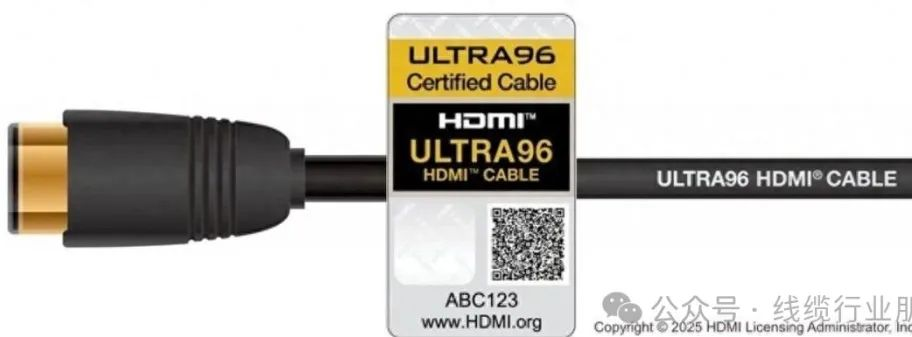
HDMI 2.2 cables must be marked with the words “ULTRA96″, which indicates that they support a bandwidth of up to 96Gbps.
This label ensures that the buyer purchases a product that meets their requirements, as the current HDMI 2.1 cable has a maximum bandwidth of only 48 Gbps. The HDMI Forum will test each length of cable to ensure compliance, and the label must be affixed to the cable.
HDMI 2.2 can transmit content at a maximum resolution of 12K at 120 fps or 16K at 60 fps to supported devices, and it also supports lossless full-color formats, such as 8K HDMI resolution at 60 fps / 4:4:4 and 4K resolution at 240 fps / 4:4:4, with a color depth of 10-bit and 12-bit.
In addition, HDMI 2.2 is equipped with a new feature called Delay Indication Protocol (LIP), which can improve audio-video synchronization. This will be particularly useful for more complex system configurations including audio-video receivers or surround speakers.
With the HDMI Forum officially releasing the complete specifications of HDMI version 2.2, related certified cables and compatible devices are expected to be launched soon.
Interpretation of HDMI 2.2 Specifications and Challenges of Testing and Certification
In the field of digital audio and video transmission, HDMI (High-Definition Multimedia Interface) holds a leading position. According to the data released by the HDMI Licensing Administrator (HDMI LA) at the CES 2025 conference, the number of devices supporting HDMI exceeded 900 million units in 2024, and the cumulative total shipment volume has approached 1.4 billion units. As market demands for higher resolutions, higher refresh rates, and more immersive experiences continue to rise, such as the popularization of next-generation gaming TVs with 4K@240Hz and AR/VR applications, the HDMI Forum has officially announced the HDMI 2.2 specification. The following is an interpretation of the three core technological innovations of HDMI 2.2. The three core technological innovations of HDMI 2.2 According to the release by the HDMI Forum, the upgrade of HDMI 2.2 mainly focuses on three core functions, aiming to meet the development needs of audio-visual technology in the next decade: 1. Bandwidth doubling: Moving towards 96Gbps FRL technology. The most notable upgrade is the direct doubling of the maximum bandwidth from HDMI 2.1′s 48Gbps to 96Gbps. This leap is achieved through the new “Fixed Rate Link (FRL) technology”. This astonishing bandwidth increase will unlock unprecedented audio-visual capabilities, including: (1) Supporting higher-specification images without compression: Capable of natively supporting 4K@240Hz, 8K HDMI@120Hz, and other ultra-high-quality and high-refresh-rate image formats. (2) Reserving space for the future: Through video compression technology (DSC), it can support astonishing specifications such as 8K HDMI@240Hz, 10K@120Hz, and even 12K@120Hz. (3) Meeting professional and commercial applications: Providing a solid foundation for applications requiring large data transmission, such as AR/VR/MR, medical imaging, and large digital panels. 2. New Ultra96 HDMI® Cable and Certification Program; To carry the massive traffic of up to 96Gbps, the HDMI 2.2 specification includes a new “Ultra96 HDMI® Cable”. This cable will become part of the HDMI Ultra Certification Program, meaning that each different model and length of cable (such as Slim HDMI, OD 3.0mm HDMI, Right Angle HDMI) must undergo strict testing and certification before being available for sale. HDMI LA emphasized at the conference the importance of supply chain compliance, including the crackdown on unauthorized and non-compliant products. This means that official certification will be more important than ever. This move ensures that consumers can purchase products that meet the specifications and can move freely in the global market. 3. The savior of audio-visual synchronization: The Latency Indication Protocol (LIP) causes the lip movement to not match the sound, which is a nightmare for many home theater or complex audio-visual system users. Especially in scenarios where the signal passes through multiple devices (such as a game console -> AVR -> TV) in a “multiple-hop” manner, the delay problem becomes even more severe. HDMI 2.2 introduces a brand-new Latency Indication Protocol (LIP), which enables the source device and the display device to communicate their respective delay conditions, allowing the system to synchronize audio and video more intelligently and efficiently, significantly improving the user experience. HDMI 1.4 vs 2.1 vs 2.2 Specification Comparison To better understand the technological innovations of HDMI 2.2, the following comparison table has been specially compiled:
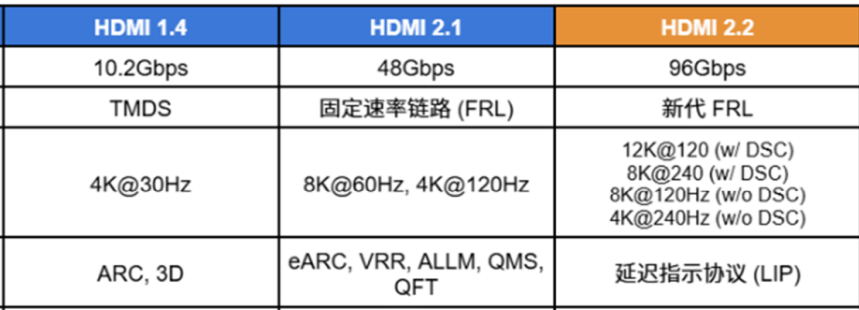
The Challenges of HDMI 2.2 Testing and Certification The release of HDMI 2.2 will bring several new challenges at different levels:
1. Physical Layer (PHY) Testing: The extreme challenge lies in signal integrity (Signal Integrity). With a bandwidth of 96 Gbps, the ultra-high bandwidth imposes unprecedentedly strict requirements on signal integrity. During the testing process, we need more precise instruments to analyze key indicators such as eye diagrams, jitter, insertion loss, and crosstalk to ensure the stability of the signal during high-speed transmission. Cables and connectors: The new Ultra96 cables (including Flexible HDMI, MINI HDMI Cable, MICRO HDMI Cable) must pass more stringent testing standards, and their performance at high frequencies will be the focus of the certification. The official authorized testing center (ATC) will closely collaborate with the HDMI Forum to establish a complete testing solution.
2. Protocol Layer (Protocol) Testing: The complexity of protocol testing has increased dramatically. LIP protocol verification: The Delay Indication Protocol (LIP) is a new feature that requires specialized protocol testing instruments to simulate various multi-hop device scenarios and verify the accuracy of protocol communication between sources, relays, and display devices. Massive format combinations: HDMI 2.2 supports an extremely large combination of resolutions, refresh rates, chroma sampling, and color depths. During testing, it is necessary to ensure that the product can correctly negotiate and display in various combinations (such as 144Hz HDMI, 8K HDMI), especially when DSC compression is enabled, which will significantly increase the complexity and time of testing.
HDMI 2.2′s Release Marks an Important Milestone in Audio-Visual Interface Technology Development. It is not only an increase in bandwidth, but also represents the beginning of a new ecosystem that can cope with higher quality and more interactive experiences in the next decade. Although the widespread adoption of HDMI 2.2 products is still some time away, the update of technology has never stopped. Ultra96 cables (including Slim HDMI, Right Angle HDMI, MICRO HDMI Cable) are expected to enter the market in the third or fourth quarter of 2025. Let’s jointly welcome the arrival of the new era of ultra-high picture quality with HDMI 2.2.
Post time: Aug-04-2025


