
Type-C and HDMI Certification
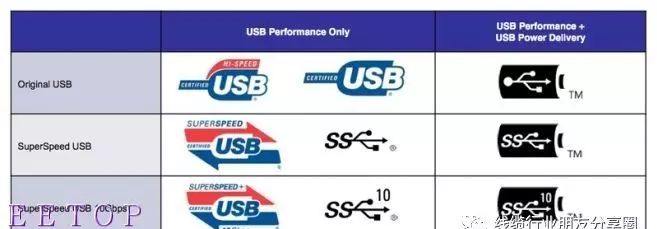
TYPE-C is a member of the USB Association family. The USB Association has developed from USB 1.0 to today’s USB 3.1 Gen 2, and the logos authorized for use are all different. The USB has clear requirements for the marking and use of logos on product packaging, promotional materials, and advertisements, and requires the user units to try to use consistent terms and patterns, and must not unintentionally or deliberately confuse consumers.

USB Type-C is not USB 3.1. USB Type-C cables and connectors are a supplement to the USB 3.1 10Gbps specification and are part of USB 3.1, but it cannot be said that USB Type-C is USB 3.1. If a product belongs to USB Type-C, it does not necessarily support USB power delivery or meet the USB 3.1 specification. Device manufacturers can choose whether their products support USB power delivery or USB 3.1 performance, and there is no mandatory requirement. In addition to the following icon-based identifiers, the USB Implementers Forum has also designed new text identifiers “USB Type-C” and “USB-C” for the latest USB Type-C. However, these trademarks can only be used on products that comply with the USB Type-C cable and connector specification (such as USB Type-C Male to Female, USB C Cable 100W/5A). The trademark announcement symbol must include the original “USB Type-C” or “USB-C” in any material, and USB Type-C and USB-C cannot be translated into languages other than English. The USB-IF does not recommend the use of other text trademarks.
HDMI
With the release of HDMI 2.0/2.1 versions, the era of OD 3.0mm HDMI, 90 L HDMI Cable, 90-degree Slim HDMI 4K and 8K high-definition display has arrived. The HDMI Association has become increasingly strict in protecting intellectual property rights, and even established a specialized anti-counterfeiting center in the Asia-Pacific region to assist its members in obtaining more market orders and maintaining the quality assurance of certified products in the market. It has clear requirements for product packaging, promotional materials, advertising labels and usage scenarios, requiring users to use consistent terms and patterns and not to intentionally or unintentionally confuse consumers.
HDMI, the full English name of which is High Definition Multimedia Interface, is an abbreviation for high-definition multimedia interface. In April 2002, Hitachi, Panasonic, PHILIPS, SONY, THOMSON, TOSHIBA and Silicon Image, seven companies, jointly formed the HDMI organization. HDMI can transmit high-definition video and multi-channel audio data without compression with high quality, and the maximum data transmission speed is 10.2 Gbps. At the same time, it does not require digital/analog or analog/digital conversion before signal transmission, ensuring the highest quality audio and video signal transmission.Slim HDMI, as one of the HDMI series, is widely used in portable devices. HDMI 1.3 not only meets the current highest resolution of 1440P, but also supports the most advanced digital audio formats such as DVD Audio, and can transmit digital audio in eight-channel at 96kHz or stereo at 192kHz. It only requires one HDMI cable for connection, eliminating the need for digital audio wiring. Meanwhile, the additional space provided by the HDMI standard can be applied to future upgraded audio-video formats. It is capable of handling a 1080p video and an 8-channel audio signal. Since the demand for a 1080p video and an 8-channel audio signal is less than 4GB/s, HDMI still has ample room. This allows it to connect a DVD player, receiver, and PRR with one cable. Additionally, HDMI supports EDID and DDC2B, so devices with HDMI have the “plug-and-play” feature. The signal source and display device will automatically “negotiate” and automatically select the most suitable video/audio format. HDMI cable serves as the transmission medium and is the key to achieving these functions. Moreover, the HDMI interface is the physical basis for device connection, while the HDMI adapter can expand its connection range, and the HDMI splitter can meet the demand for simultaneous display of multiple devices.
Post time: Jul-23-2025


