
USB 3.1 and USB 3.2 Introduction (Part 2)
Does USB 3.1 include the Type-C connector?
For consumers using USB 3.1 devices (including mobile phones and laptops), the Type-C connector is becoming increasingly popular. It is reversible and can be used on the host device side. It also has additional pins that can support other serial protocols and provides forward compatibility with future versions of the USB specification. The Type-C connector is independent of the USB 3.1 specification; there is no guarantee that Type-C products will necessarily support USB 3.1 transfer speeds. Common cable specifications include Type C Male TO Male, usb c male to male, usb type c male to male, male to male usb c, and various adapter solutions such as USB C Male To Female, Type C Male To Female, and USB Type C Male To Female.

FLIR currently does not offer any Type-C products, but we are closely monitoring the Type-C ecosystem. We hope it will continue to develop, including a wide range of industry-focused products, such as screw-locking, highly flexible, and extended temperature-range cables. For example, USB-C 3.2 Male to extension cable, USB-C 3.1 Male to female cable, or USB C Male right angle.
USB power output
The new USB power output specification has been developed in parallel with USB 3.1 to meet the growing consumer demands. With this new specification, the power that compatible hosts can provide to devices has increased from 4.5W per port to 100W. The USB power output standard includes the new PD sensing cable, which can be used for the “handshake” between the host and the device. After powering on the device, a maximum of 20V x 5A of power can be requested from the host. First, the cable must be checked to ensure that it can safely output the requested power within the rated capacity. Then, the host can output power exceeding 5V x 900mA. If the cable confirms support for higher power, the host will provide higher power. Ports that support USB power output and have a voltage greater than 5V or a current greater than 1.5A may be marked with the USB power output logo. Like the Type-C connector, USB power output is not included in the USB 3.1 specification. Cables that support high-power transmission are often labeled as 5A 100W, 5a 100w usb c cable, USB C Cable 100W/5A, or 5A 100W USB C Cable, and support Pd Data transmission.

Figure 3. Icons for the SuperSpeed USB (a) and SuperSpeed USB 10 Gbps (b) ports, supporting USB power output to provide more than 4.5W of power. USB Type-C chargers that support USB power output may display an icon indicating the maximum power capacity (c).
All FLIR USB 3.1 cameras consume less than 4.5W of power; they do not require PD sensing cables or host-end USB power output support.
What will be included in the upcoming USB 3.1 version?
FLIR is looking forward to developing new machine vision technologies that are compatible with the development of the USB standard. Please be sure to keep an eye on future updates! Visit our current list of the first generation of USB 3.1 camera models.
New USB 3.2 Specification
The USB Implementers Forum recently released relevant specifications for the USB 3.2 standard. The updated standard doubles the throughput of the first and second generations of USB 3.1 by using both ends of the USB Type-C™ cable simultaneously. This will give rise to new cable types, such as USB 3.2 extension cord, USB-C 3.2 right angle cable, 90-degree USB 3.2 cable, etc.
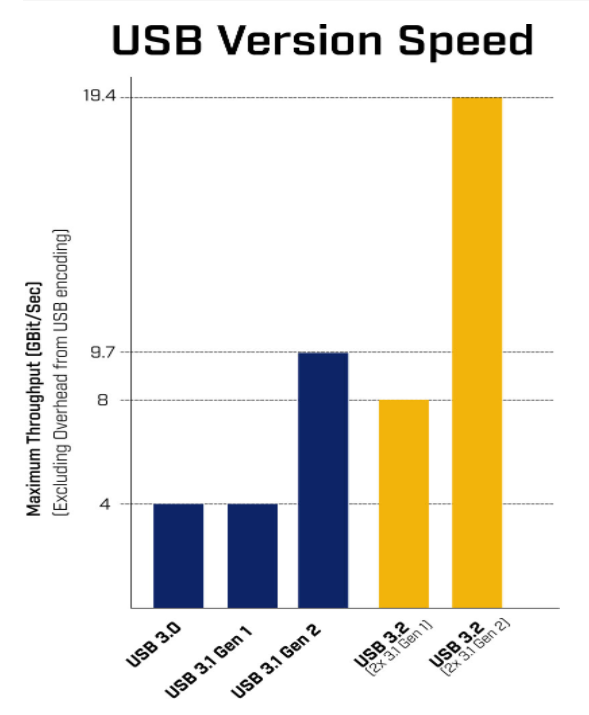
● Doubling the throughput of USB 3.1 Gen 1 will still be lower than that of USB 3.1 Gen 2.
● Doubling USB 3.1 Gen 2 is quite interesting, although the maximum cable length will be 1 meter.
Using the term “USB 3.2″ to represent the first and second generations is likely to cause confusion. “Devices certified by USB 3.2″ can be understood as those capable of achieving a transmission speed of 20 Gbit/s over a cable longer than 1 meter, or 8 Gbit/s over a cable longer than 5 meters. We will continue to monitor and report on the progress of this standard and its naming.
Post time: Aug-25-2025


