
USB 3.2 Popular Science (Part 2)
In the USB 3.2 specification, the high-speed feature of USB Type-C is fully utilized. USB Type-C has two high-speed data transmission channels, named (TX1+/TX1-, RX1+/RX1-) and (TX2+/TX2-, RX2+/RX2-). Previously, USB 3.1 only used one of the channels to transmit data, with the other channel existing as a backup. In USB 3.2, both channels can be enabled under appropriate circumstances and achieve a maximum transmission speed of 10 Gbps for each channel, resulting in a total of 20 Gbps. With 128b/132b encoding, the actual data speed can reach approximately 2500 MB/s, which is a direct doubling compared to the current USB 3.1. It is worth noting that the channel switching in USB 3.2 is completely seamless and does not require any special operations from the user.
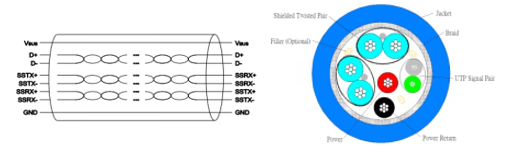
The signal and shielding processing method of the USB3.1 cable is consistent with that of USB3.0. The impedance control of the SDP shielded differential line is controlled at 90Ω ± 5Ω, and the single-ended coaxial line is controlled at 45Ω ± 3Ω. The internal delay of the differential pair is less than 15ps/m, and the other insertion loss and other indicators are consistent with USB3.0. The cable structure is selected according to the application scenario and the function and category requirements: VBUS: 4 wires to ensure the flow of voltage and current; Vconn: Different from VBUS, it only provides a voltage range of 3.0~5.5V; only supplies power to the chip of the cable; D+/D-: USB 2.0 signal; to support forward and reverse insertion, there are two pairs of signals on the socket side; TX+/- and RX+/-: 2 groups of signals, 4 pairs of signals, supporting forward and reverse insertion; CC: configuration signal, confirming and managing the connection between the source and the terminal; SUB: expansion function signal, can be used for audio.
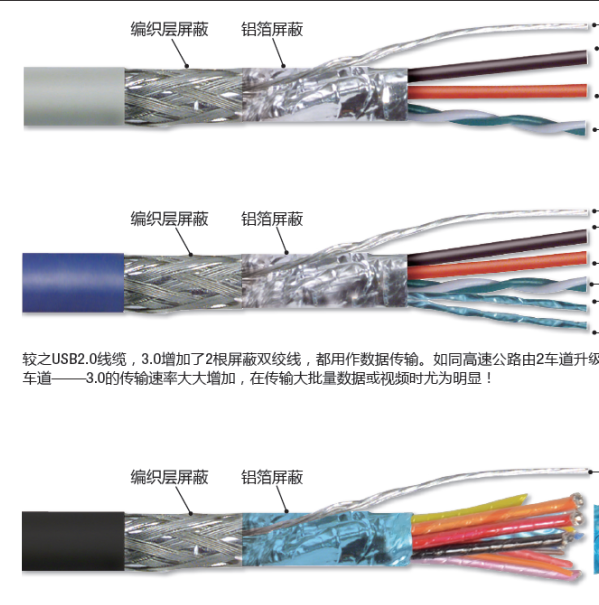
If the impedance of the shielded differential line is controlled at 90Ω ± 5Ω, and a coaxial line is used, the signal ground return is through the shielded GND. For single-ended coaxial lines, the impedance is controlled at 45Ω ± 3Ω. However, the choice of connection points and cable structure depends on the application scenarios and the length of the different cables.
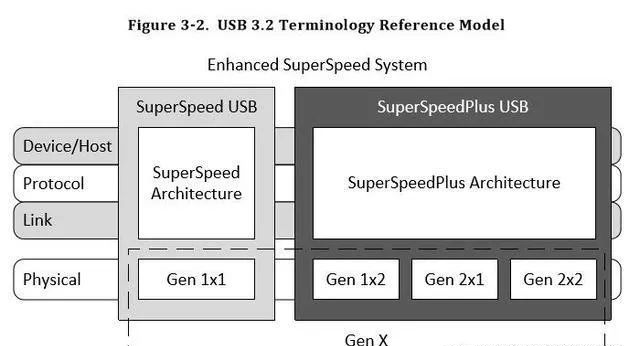
USB 3.2 Gen 1×1 – SuperSpeed, 5 Gbit/s (0.625 GB/s) data signaling rate over 1 lane using 8b/10b encoding, the same as USB 3.1 Gen 1 and USB 3.0.
USB 3.2 Gen 1×2 – SuperSpeed+, new 10 Gbit/s (1.25 GB/s) data rate over 2 lanes using 8b/10b encoding.
USB 3.2 Gen 2×1 – SuperSpeed+, 10 Gbit/s (1.25 GB/s) data rate over 1 lane using 128b/132b encoding, the same as USB 3.1 Gen 2.
USB 3.2 Gen 2×2 – SuperSpeed+, new 20 Gbit/s (2.5 GB/s) data rate over 2 lanes using 128b/132b encoding.
Post time: Aug-18-2025


