
Modern consumer, medical, automotive and industrial electronics keep getting thinner and more compact, while demanding higher‑speed signal performance. Designers face big challenges: limited internal space, strict EMI requirements, and stable transmission for eDP, LVDS, MIPI and camera interfaces. That is where micro‑coaxial cable becomes your ideal interconnect solution.
Micro‑coaxial cable is a precision signal wire specially engineered for miniaturized, high‑density electronic equipment. Thanks to its native coaxial architecture, it delivers tight impedance control and outstanding shielding performance. It effectively suppresses EMI interference, crosstalk and high‑frequency signal loss, satisfying high‑reliability high‑speed signal transmission requirements for today’s compact hardware.
With ultra‑small outer diameter, great flexibility, small footprint and excellent high‑frequency characteristics, micro‑coaxial cable assemblies are widely deployed in laptops, tablets, display monitors, camera modules, medical devices, automotive electronics and industrial equipment。
 |
 |
 |
Typical Structure of Micro‑Coaxial Cable
A standard micro‑coaxial cable consists of four core layers from inside to outside:
Center Conductor → Insulation Layer → Shield Layer → Outer Jacket
- Center Conductor: High‑conductivity conductor material. Tin‑plated or silver‑plated coated copper conductors are selectable based on project electrical requirements.
- Insulation Layer: Delivers consistent electrical insulation and controls characteristic impedance of the cable.
- Shield Layer: Adopts braided or wound shielding construction to minimize external electromagnetic interference and inter‑channel crosstalk.
- Outer Jacket: Provides mechanical protection, wear‑resistance and environmental durability. Different jacket materials can be chosen to fit tight device‑internal routing space。
Key Benefits of Micro‑Coaxial Cables
1. Ultra‑Fine Outer Diameter for Space‑Saving
Micro‑coaxial cables feature extremely thin outer diameters, greatly saving valuable internal space inside finished devices. Perfect for lightweight, miniaturized and high‑density electronic product designs.
2. Reliable High‑Speed Signal Transmission
Its coaxial physical structure brings excellent high‑frequency electrical properties. It supports high‑speed digital and RF signal transmission for mainstream interfaces including eDP, LVDS, MIPI, camera and RF applications.
3. Superior EMI Shielding & Low Crosstalk
Multi‑layer shielding cuts electromagnetic interference and radio‑frequency noise. It also greatly reduces crosstalk between adjacent signal channels and improves overall system signal integrity.
4. Precise & Stable Impedance Control
Accurate manufacturing of conductors, dielectric insulation and shielding layers achieves stable characteristic impedance. This reduces signal reflection and waveform distortion during high‑speed data transfer.
5. Excellent Mechanical Flexibility
Precision flexible construction handles complex bending and tight routing paths inside compact electronics. Suitable for constrained installation spaces where repeated flexing occurs.
6. High‑Density Multi‑Channel Layout
Multiple micro‑coaxial wires can be arranged under different pitch specifications. Multi‑channel signal transmission is realized within limited space to boost device‑internal connection density.
Common Application Scenarios
- Consumer electronics: Laptops, tablets, LCD / OLED monitors, AR‑VR headsets
- Imaging modules: Built‑in cameras, industrial vision cameras
- Medical equipment: Compact diagnostic and portable medical instruments
- Automotive electronics: On‑board display panels, ADAS camera systems
- Industrial devices: Compact industrial control panels, embedded hardware
Custom Micro‑Coaxial Cable Assemblies
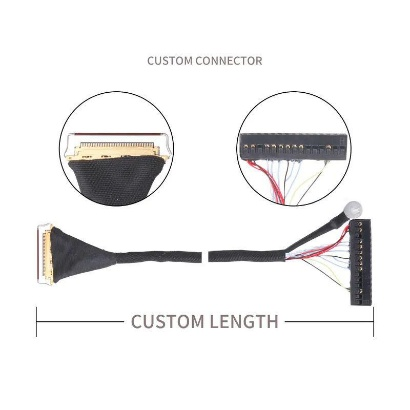
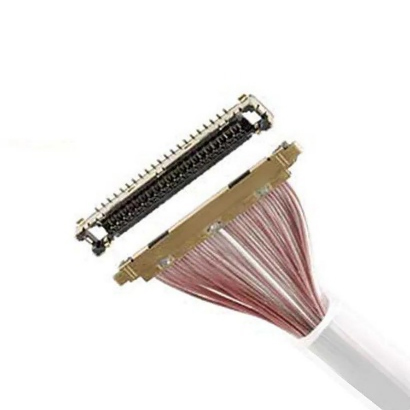
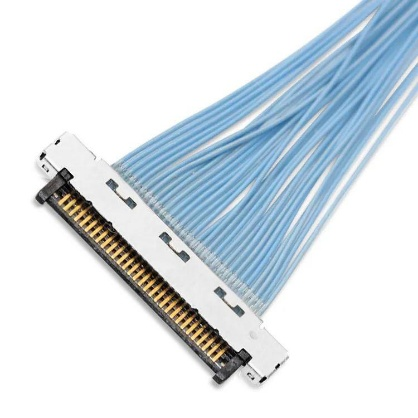
Beyond bare single micro‑coaxial wire, JD‑Cables provides fully finished custom micro‑coaxial cable assemblies, tailored for your mechanical footprint and electrical performance targets.
We support customization of below parameters for your project:
- Cable finished length
- Cable outer diameter
- Conductor wire gauge / size
- Target characteristic impedance
- Shielding construction
- Number of coaxial cores
- Connector pitch
- Connector type (compatible with I‑PEX, JAE, KEL, Hirose series connectors)
- Connector orientation
- Contact plating options
- Outer jacket material
- Full assembly configuration
From prototype validation through mass‑volume production, we turn your drawing and specification requirements into production‑ready cable assemblies. Explore our micro‑coaxial cable products for reference.
FAQ for Micro‑Coaxial Cables
Q1: What is the difference between micro‑coaxial cable and ordinary FPC flat cable?
A1: Micro‑coaxial cable uses independent coaxial structure for each signal wire with superior shielding and high‑frequency performance. FPC is cheaper for low‑speed signals but suffers higher crosstalk at high‑speed rates. Micro‑coax is preferred for eDP / MIPI / LVDS high‑speed image transmission.
Q2: Can I get custom‑terminated micro‑coaxial assemblies with my target connectors?
A2: Yes. JD‑Cables offers full‑service custom assembly, including crimping / soldering various micro‑high‑density connectors according to your BOM and drawings.
Q3: What key specs should I prepare for RFQ of micro‑coaxial cable assemblies?
A3: Prepare cable length, impedance target, core count, pitch, connector part‑numbers, bend‑radius requirement, working environment and expected order volume. Sending drawings will speed up quotation significantly.
Get Your Custom Micro‑Coaxial Cable Solution
If you are developing compact high‑speed electronics and need reliable micro‑coaxial interconnect solutions, our engineering team can offer technical recommendations for your project.
Contact us to discuss your custom micro‑coaxial cable assembly requirements.
Post time: Sep-28-2026


