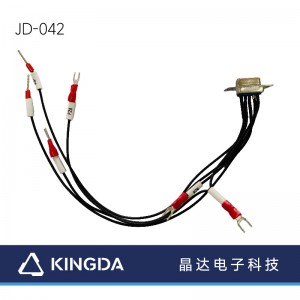
Extension 30PIN LVDS Cable Assembly , Df19-30s To Df19-30s Discrete Wire Lvds Cable


Applications:
LVDS (Low Voltage Differential Signaling, low voltage differential signaling) cables are high-speed differential transmission lines, widely used in display, industrial control and high-speed data connection fields.
- Detail:
The cables are made of special materials and through professional production processes, ensuring stable transmission and long-lasting durability.
Product Detail Specifications

Cable Length 0.3M /1M
Color Black or others
Connector Style Straight
Product Weight
Wire Gauge 30~36 AWG
Wire Diameter
Packaging InformationPackage
Quantity 1Shipping (Package)
Weight
Maximum Digital Resolutions
Product Detail Specifications
Connector(s)
Connector A Df19-30s
Connector B Df19-30s
Extension Cable Assembly Df19-30s To Df19-30s Discrete Wire Lvds
Gold Plated
Color Black or White

Specifications
|
Connector Type |
Contact, Socket, Header, Others |
|
Number of Positions |
8, 14, 20, 30 |
|
Mounting Pitch |
1 mm |
|
|
|
|
Rated Current |
1 A |
|
Rated Voltage (AC) |
AC 100 V |
|
Mating/Unmating Cycles |
30 |
|
Connector Orientation |
Straight, Right angle |
|
Mounting Side |
Standard on-Board, Standard off-set, Reverse off-set |
|
Wire Termination Method |
Soldering, Crimping, FPC termination |
|
Recommended Wire Type |
FPC, Discrete wire, Micro-coaxial cable |
|
Recommended Min. Wire Size (AWG) |
AWG 30, 32, 36 |
|
Recommended Max. Wire Size (AWG) |
AWG 28, 30, 36 |
|
Operating Temperature (Max.) |
85 ℃ |
|
Operating Temperature (Min.) |
-35 ℃ |
Why Choose LVDS Cable?
High-Speed Differential Cable for Reliable Display and Data Transmission
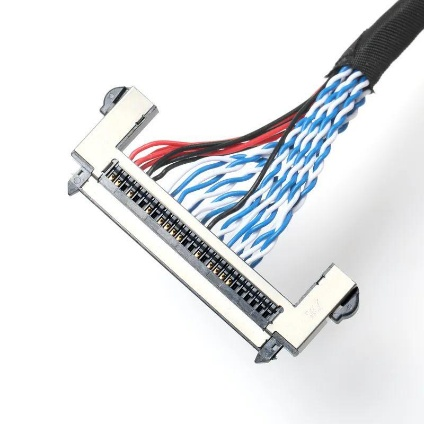
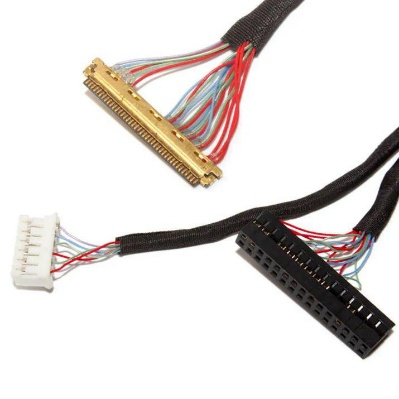
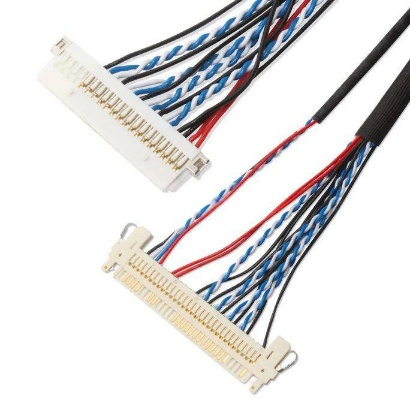
LVDS Cable is widely used in LCD Displays, LED Displays, Notebooks, Monitors, Industrial Displays, Medical Equipment, Automotive Electronics, and other electronic devices that require high-speed differential signal transmission.
We can provide complete solutions ranging from standard LVDS Cable to custom LVDS Cable Assembly, and can be customized according to the customer’s transmission rate, channel quantity, cable structure, length, impedance, shielding method, and connector requirements.
 |
 |
 |
Product Structure
The typical LVDS cable can adopt twisted-pair, parallel-line or micro-coaxial structure depending on different applications.
Typical Structure
Conductor → Insulation → Twisted Pair / Differential Pair → Shield → Outer Jacket
For high-density and high-speed applications, the following methods can also be adopted:
Micro Coaxial Structure → Shielding → Cable Assembly
Conductor
The conductor is responsible for the transmission of high-speed differential signals, and the choice can be made according to the application requirements:
Bare Copper
Tinned Copper
Silver-Plated Copper
Copper Alloy
The appropriate conductor material can be selected based on electrical performance, flexibility, wire diameter and application environment.
Common structures include:
Twisted Pair
Parallel Pair
Shielded Pair
Micro Coaxial Pair
I Key Advantages
1. High-Speed Differential Signal Transmission
LVDS employs differential signal transmission technology, which can meet the requirements of high-speed data transmission and is suitable for applications such as display, image processing, and high-speed data interfaces.
2. Excellent Noise Immunity
Differential transmission can effectively suppress common-mode noise and maintain stable signal transmission performance in complex electromagnetic environments.
3. Low EMI
LVDS uses low-voltage differential signals, which can reduce signal swing and electromagnetic radiation, thereby helping to meet the EMC/EMI requirements of electronic devices.
4. Low Power Consumption
The lower signal voltage swing enables LVDS to have excellent power consumption performance during high-speed transmission, making it suitable for electronic devices with high requirements for power consumption and heat dissipation.
5. Controlled Differential Impedance
By precisely controlling the spacing of conductors, the thickness of insulation layers, the structure of wire pairs, and the shielding method, stable differential impedance can be achieved, reducing reflections and distortions in the transmission of high-speed signals.
6. Low Crosstalk
A reasonable Pair Structure, Twisting Ratio and Shielding Design can reduce crosstalk between different signal channels and enhance the reliability of multi-channel high-speed transmission.
7. Flexible Cable Design
The LVDS cable can adopt different wire diameters, core numbers, arrangement methods and shielding structures according to the internal space of the equipment, making it suitable for narrow spaces and complex wiring environments.
Customized Cable Assembly
we can from Cable Design → Material Selection → Differential Pair Design → Connector Matching → Cable Assembly → Electrical Testing,Provide a complete LVDS Cable solution.